
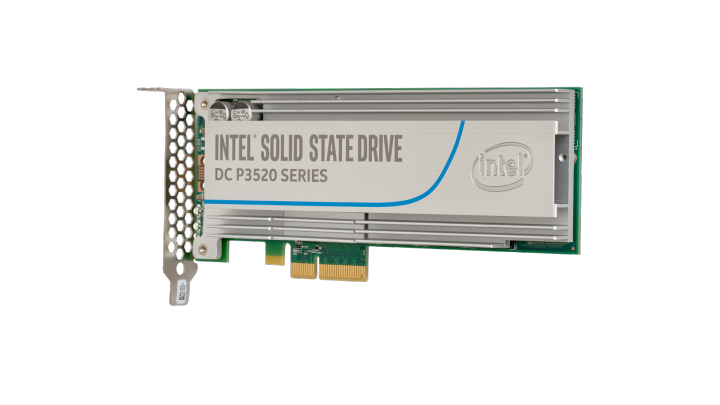
The P3520 series of Intel Datacenter SSDs, introduced in August, enables you to upgrade your storage solutions from SATA SSDs or conventional hard drives to the latest NVMe technology in a cost-effective manner. The new Intel Datacenter SSDs use 3D NAND flash memory, allowing higher capacities at lower manufacturing costs. As a result, the price-performance ratio can be significantly improved compared to traditionally manufactured planar NAND modules.
Similar to the already established DC P3600 and DC P3700 SSDs, the new model utilizes the PCIe interface and NVMe protocol, delivering high bandwidth and low latency. Through the use of 3D flash memory, Intel increased the capacity per die (commonly referred to as memory cell) to 256Gbit. This significantly reduced the cost per gigabyte of storage while also lowering power consumption, ultimately improving overall efficiency. The integrated MLC flash enables endurance of three Drive Writes per Day (DWPD), clearly positioning the drive within the enterprise flash storage segment.
Symbol image of an Intel Datacenter SSD from the P3520 Series in PCIe low-profile format:
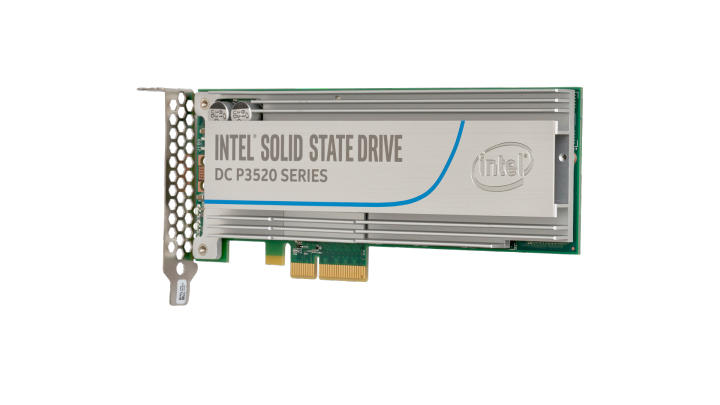
Write Speeds and Form Factors of the DC P3520 Series
Sequential transfer rates reach up to 1.6GB/s for read access and also deliver strong write performance of up to 1.4GB/s. Input/output operations per second are lower than those of the “larger” enterprise counterparts, but still operate at a high level with 375,000 read IOPS and 26,000 write IOPS. Since the DC P3520 series is significantly more cost-effective in comparison, it is particularly suitable for read-optimized workloads.
The new model is available both as a PCIe expansion card and in a 2.5″ form factor. The only exception is the smallest 450GB model, which is available exclusively as a 2.5″ NVMe SSD. Additional models with capacities of 1.2TB or 2TB are available in both formats (PCIe low-profile expansion card or 2.5″ 15mm form factor).
Especially in the targeted data center segment, the new NVMe series represents a cost-effective alternative to more expensive enterprise product lines, as its existing limitations can easily be compensated through the parallelization already common in these environments. Integrated hardware encryption (AES 256-bit) and End-to-End Data Protection technology also meet high requirements for data security and consistency.
Additional models in the series are expected in the future, where capacities can be further increased through the use of TLC flash memory (Triple Level Cell).
Overview of the Intel Datacenter SSDs of the P3520 Series

Recent Blogs
New HPC / AI servers based on the AMD Instinct MI300 series
Posted onWith the MI300X Series, a new player has appeared on the GPU market that will reshuffle the cards in the AI sector. AMD Instinct™ MI300X…

We have moved – With our own new building, we are ready for the future
Posted onAfter nine months of construction, we were able to move into our new company building at the beginning of July. Our customers can now find…
Datacenter SSDs für den absoluten Performance-Boost
Posted onNoch keine Enterprise SSDs im Datacenter im Einsatz? Worauf warten Sie noch? Im Consumer Bereich haben SSDs längst Einzug gehalten. Und wer heute die Ladezeiten…