
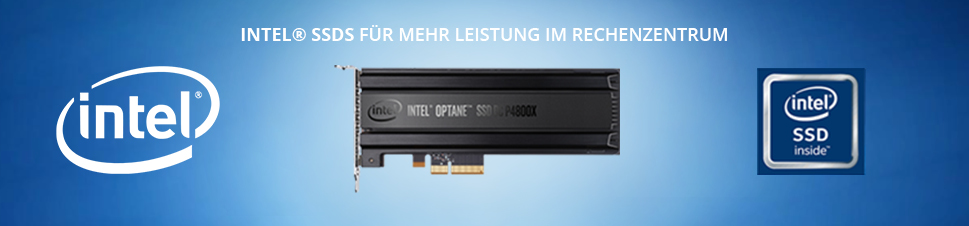
Intel Optane SSD – DC P4800X
The newly introduced Intel Optane SSD series revolutionizes the use of Intel Optane SSDs (NVMe) from datacenters all the way to small business environments.
With the 3D XPoint technology used by the Intel Optane SSD DC P4800X, a bridge is created between DRAM and mass storage, enabling up to a 28% increase in system performance. This innovation impacts every enterprise server, as Intel utilizes Optane SSDs together with DRAM as an extension to the system’s existing memory.
In Intel’s Optane SSD example, a dual Xeon system equipped with 678 GB RAM was used together with a 675 GB MySQL database as an enterprise use case for Optane SSD technology. By reducing the system memory to 128 GB RAM and deploying two 375 GB Optane SSDs, a total of 550 GB RAM was replaced by 750 GB Intel Optane SSD storage. Despite this, database performance decreased by only 20%.
With this technology, the performance of the Intel Optane SSD DC P4800X can be utilized to expand a dual-socket processor system with up to 24 TB of Intel Optane SSD memory. In a 4-socket system example, up to 48 TB of Intel Optane enterprise SSD storage can be added as system memory.

Thanks to the simple integration of the Intel Optane SSD DC P4800X, this enterprise SSD is also an excellent choice for retrofitting system performance or implementing high-speed caching solutions. Whether integrated via classic PCIe or through interfaces such as M.2 or U.2, it creates an impressively responsive bridge between slower mass storage and instantly required data.
Using Intel Memory Drive Technology, SSDs can be utilized to expand system memory. The SSD storage is presented to the operating system and applications as DRAM. This bypasses traditional DRAM limitations and adds additional memory performance to the system.
This provides a solution to many performance bottlenecks, where previously only a complete replacement with a more powerful enterprise system would have delivered the required performance improvements. Use cases are even possible with 7th Generation Intel Core processors. These processors use Intel Optane SSDs as a medium for storing frequently accessed data, creating a bridge between the processor and slower SATA drives.
Take advantage of Optane technology and gain a complete overview of the Intel SSD portfolio as well!
Recent Blogs
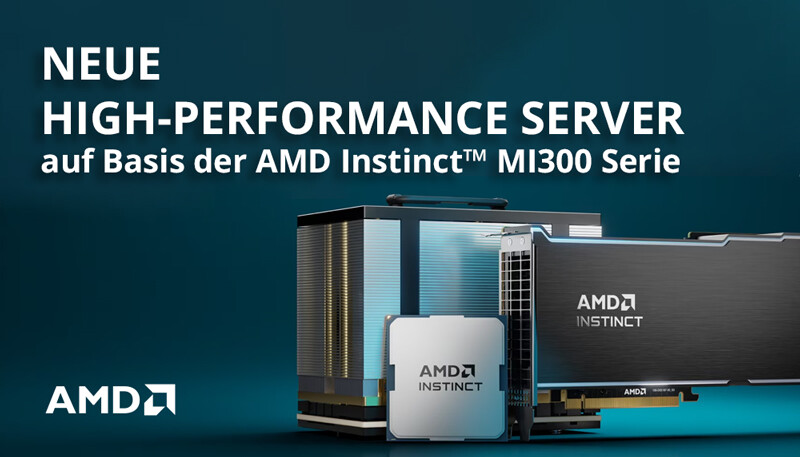
New HPC / AI servers based on the AMD Instinct MI300 series
Posted onWith the MI300X Series, a new player has appeared on the GPU market that will reshuffle the cards in the AI sector. AMD Instinct™ MI300X…

We have moved – With our own new building, we are ready for the future
Posted onAfter nine months of construction, we were able to move into our new company building at the beginning of July. Our customers can now find…
Datacenter SSDs für den absoluten Performance-Boost
Posted onNoch keine Enterprise SSDs im Datacenter im Einsatz? Worauf warten Sie noch? Im Consumer Bereich haben SSDs längst Einzug gehalten. Und wer heute die Ladezeiten…